

Jessica Henke, 2004
MED 231 Australian Cinema
Critical Review and Bibliography
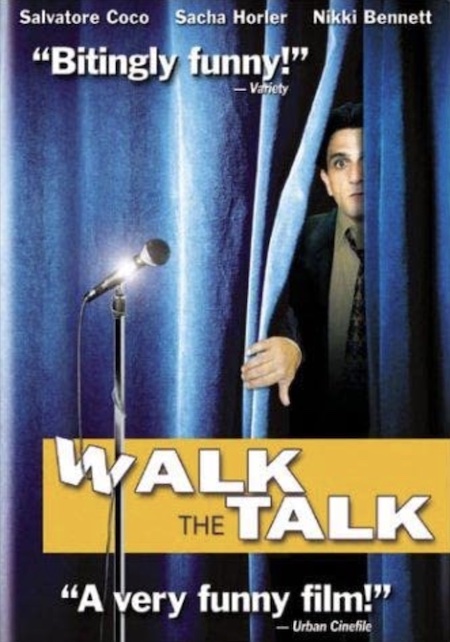
WALK THE TALK
Running time: 111 minutes
Cast:
Salvatore Coco: Joey Grasso
Sacha Horler: Bonita
Nikki Bennett: Nikki Raye
Carter Edwards: Marty Raye
Robert Colby: Pastor Bob
Skye Wansey: Barbara Jacobs Alsop
John Burgess: Rex Hanna
Jon English: Phil Wehner
Nicki Wednt: Linda Mundell
David Franklin: Trevor Whitney
Bille Brown: Barry
Credits:
DIRECTOR: Shirley Barrett
ORIGIONAL SCREENPLAY: Shirley Barrett
PRODUCER: Jan Chapman
CINEMATOGRAPHER: Mandy Walker
PRODUCTION DESIGNER: Steven Jones- Evans
PRODUCTION COMPANY: Dreamworks SKG [us]
Pacific Film and Television Commission [au]
Release Dates
Canada – 9 September 2000 (Toronto Film Festival)
Australia – 15 March 2001
Video/DVD release – 12 August 2003
Interviews
Interviews with Shirley Barrett (Director) –
Andrew L Urban interviews Shirley Barrett - http://www.urbancinefile.com.au/home/view.asp?a=4660&5=visionstream
Shirley Barrett talks about the making of Walk The Talk - http://www.sbs.com.au/movieshow/interviews.php3?id=15
Interview with Jan Chapman (Producer)
Radio interview 102.7FM
http://www.allmedia.com.au/fbfwmp/janchapman.asf
Rose Capp interviews Jan Chapman http://www.sensesofcinema.com/contents/02/23/chapman_interview.html
Interview with Mandy Walker (Cinematographer)
· Rose Capp interviews Mandy Walker http://www.sensesofcinema.com/contents/02/23/walker.html
Reviews
· The movie show – http://www.sbs.com.au/movieshow/reviews.php3?id=514
· Variety.com -http://www.variety.com/review/VE1117787901?categoryid=31
· Empire Magazine -http://www.empireonline.com.au/new/html/past/films/review.asp?MovieID=352
· Vince Leo review - http://www.qwipster.net/walkthetalk.htm
On-line Presence
The following web sites contain literature on the film Walk The Talk
· EMPIRE - The magazine behind the screen.
· Urban Cinefile Feature
· Walk the Talk - Coming Soon! Film Database
· http://www.hollywood.com/celebs/detail/celeb/195664
· Film Buffs' Forecast - with Paul Harris & Brett Cropley - 3RRR 102.7FM - Saturday - Noon - 2
· http://movies.go.com/movies/W/walkthetalk_2000
· http://www.filmfestivalrotterdam.com/nl/film/6441.html
· http://www.electricshadows.com.au/film/1955610657
· http://www.efilmcritic.com/review.php?movie=4445&reviewer=1
· http://www.amazon.com/exec/obidos/tg/detail/-/B00009XFQO?v=glance
Research
The principal source of information for this bibliography was collected from the Internet. I searched through many of the movie sites recommended in the unit outline and also looked for specific information regarding the cast and credits. Using Internet search engines such as google, I found a lot of web pages that related to the movie and spent much time sorting through the information to find what I considered to be the most relevant. Finding interviews proved to be difficult especially interviews with the cast members relating to this movie. I did however find several interviews with the director, producer and cinematographer, which I have included.
I spent some time searching for box office information but was unable to find figures, I did however read through many different reviews and the general consensus was that this film did not live up to the expectations set by Shirley Barrett's previous award winning film Love Serenade.
Critical Review
Synopsis
Walk The Talk is the story of Joey Grasso (Salvatore Coco) a man who is obsessed by self-help gurus and motivational seminars. It is at such a seminar that he meets Nikki Raye (Nikki Bennett) He watches her cry during a film about penguins and is struck by her vulnerability; He decides to help her achieve her dream of becoming a famous singer. The story essentially follows his efforts to make this dream come true. Joey is also a member of a revivalist church, which is where he met his girlfriend Bonita (Sacha Horler). Bonita is a paraplegic who has just received a large insurance payout. Joey uses his relationship with Bonita to influence her into giving him the money he needs to set up a talent agency. Using his motivational skills he attempts to turn his one and only client (Nikki) into a star. Which results in many comedic situations. In his efforts to achieve his goals Joey resorts to desperate measures. At the climax of the film he abducts Nikki and leaves a ransom note. Essentially he desires to get publicity for her and the money to pay back Bonita. His carefully laid out plan backfires when Nikki is insulted by the amount of money he has asked for and walks out on him. He decides to shoot her (not fatally) to achieve what he desires. The film concludes with a dream sequence and many loose ends.
Personal Commentary
I found the films ending to be highly unsatisfactory, the viewer is left not knowing what happens with Bonita (the character with whom I found myself feeling sympathetic.) and is left instead with the dream sequence which is beautifully filmed and choreographed but which left me feeling that I had somehow missed something. The film is cleverly written and makes good use of comedy and music to assist in the storytelling. The performances by the entirely Australian cast were fantastic and made the film quite enjoyable. I particularly enjoyed the performance of Nikki Bennett (Who played Nikki Raye) The character was written with her in mind after the writer (Shirley Barrett) saw her singing 'Miss Otis Regrets' on The Midday show. Nikki plays the part of the club singer with aplomb. Another performance, which stood out, was by Robert Coleby (who played pastor Bob). Pastor Bob was for me one of the few comedic elements of this otherwise not so funny film. I especially enjoyed the scene where he is dancing and mouthing the words to Bonita's ironic rendition of 'Walking on Sunshine'. Appearances by John Burgess (Rex Hanna) and
Jon English (Phil Wehner) as the music industry 'big wigs' also adds a comedic element to the film and they both play their parts well.
The cinematography in the film is quite beautiful. Effective use of colour and camera positioning makes this film aesthetically pleasing and works to capture the viewer's attention. All of the elements of mise-en-scene come together in this film to create a polished and interesting piece of work. Stylistically the film is very good it is the story that I feel essentially lets it down in particular the unsatisfying ending. The characterisation is also a point in which I felt the film could have been improved; by mid way through I was irritated with the lead character Joey and found it hard to be sympathetic to his plights. Shirley Barrett positioned the character of Joey to be innocent and yet manipulative and it is these contradictions, which make him such an intriguing character, despite his complexities, or perhaps because of them I found his character to have lost his charm well before the film had finished.
Critical uptake
Walk The Talk Has received mixed reviews. The general consensus seems to be that it hasn't lived up to the expectations set by Shirley Barrett's earlier award winning film Love Serenade. Many Film critics were negative in their personal opinion of the film and yet have praised its stylistic integrity and the impressive cinematography. Many of the reviews have made correlations between this film and Scorseses' King of Comedy this being said many of the critics have claimed that King of Comedy is the better film.
There were varying opinions about the films characterisation, while some have praised it and alluded to it being one of the films redeeming features, others have argued that the dark side of some of the characters especially the lead character Joey actually made it hard to watch him and in effect lessened their enjoyment of the film.
Most of the reviews where positive in regards to the performances by the Australian cast. The acting was considered to be of a high quality and the casting choices seem to be widely commended. The film was written with a subtle style of humour and the performances were considered to be conducive to the stylistic intentions.
Overall Walk The Talk did not receive a positive critique. Many of the aspects of the film where well received, but the negative opinions of the highly unsatisfactory resolution seemed to overshadow the positive elements.
Production
Shirley Barrett received international recognition for her film Love Serenade. This was her debut feature film and it won several awards including a prize of $70 000 at camera d'or in Cannes. On the strength of this she was offered 5 million dollars from David Geffen of the American company DreamWorks to make her second feature Walk The Talk. She spent a couple of years developing the script and Producer Jan Chapman came on board and helped to realise the money that had been promised.
Shirley Barrett Spoke of wanting to write a script that was character based. She spent time researching ideas for the characters and spoke of them evolving throughout the writing process. She spoke of being interested in human flaws and finding failure entertaining and that these ideas where the motivation behind this film. She read self help books and took inspiration from the ideas they contained. Ideas such as if you feel down, visit someone worse off than yourself, which is seen in the film as Joey visits the old peoples home in order to gain inspiration.
The casting for the film was mostly done early on in the production process. Shirley discovered Nikki Bennett after seeing her perform on the Midday Show and the character of Nikki Raye was written with the actress in mind. Shirley also wrote the character of Joey with Salvatore Coco in mind and tried to use the energy he possesses himself to shape the character of Joey.
Previous work
Shirley Barrett the director and writer of this film has worked on Several projects which have gained critical acclaim including: The short film Cherith (1987), The Boys From The Bush (1991), Love Serenade (1996), and Walk The Talk (2000)
Jan Chapman's producing credits include Two Friends (1987,T.V), The Last Days of Chez Nous (1992), The Piano (1993), Love Serenade (1996), Holy Smoke (1999), Walk The Talk (2000), and Lantana (2001).
Mandy Walker Has worked as a cinematographer on many films including: Return Home (Ray Argall 1989), Love Serenade (Shirley Barrett 1996), The Well (Samantha Lang 1997), Walk The Talk (Shirley Barrett 2000), Lantana (Ray Lawrence 2001), and Australian Rules (Paul Goldman 2001).
Position within Australian National Cinema
In his book Australian National Cinema O'Regan describes Australian cinema as being a 'medium-sized English language cinema' O'Regan writes of the necessity to achieve an independence from the dominating American film culture in order to be a competitive industry, while maintaining a degree of similarity which would allow it to compete on the international market. (O'Regan.T, 1996)
The use of identifiable Australian cultural indicators helps to define and position Australian films within the international film industry.
"Cultural Identities are the points of identification, the unstable points of identification or suture, which are made through the discourse of history and culture. Not an essence but a positioning." (Hall.S, 1996)
Australian cinema seeks to position itself as being an identifiable product, the differences and similarities between Australian cinema and its international counterparts are vital in its position on the international market. Compared to the Hollywood blockbuster movies Australian films are often made with significantly lower budgets. With her movie Walk the talk Shirley Barrett was lucky in that the film finance was offered to her on the strength of her previous work. Many Australian filmmakers have trouble gaining finance due to the comparatively smaller distribution market.
The cultural significance of Walk the Talk is seen in its use of identifiably Australian landscape and characterisation. The choices of locations for the film are significant in that they seek to offer the viewer an insight into the Australian lifestyle in particular they showcase the Gold Coast as an iconic representation of Australian culture.
"Scriptwriters, directors and producers select story materials from the social materials and forms at their disposal and they use combinations of technology and performance to establish fictional norms and documentary truths."(O'Regan, T, 1996)
Genre
Video retail outlets classify this film as a comedy; I found that it also has elements of a musical and a drama and could essentially be identifiable in any of these categories.
As a comedy it can be categorised by the comical undertones throughout the film it is a subtle humour but one, which is clearly identifiable by its audience, someone who enjoys this brand of subtle almost satirical humour would certainly appreciate this film.
A musical is most clearly defined as a movie in which the story is told and developed through song. Walk the talk is not told through song but music is a significant part of the story and does assist in the narrative's progression and therefore may be positioned within the musical genre.
A Drama is a hard genre to define as most movies have dramatic elements. It could be argued that it is a genre, which does not stand-alone but crosses over between all other categories and types of film. In Walk The Talk there are many dramatic even dark undertones, which could position it within the drama genre.
References
Hall,S. "Culture identity and cinematic representation" Black British Cultural Studies.
Eds-Houston A Baker, et al. Chicago: U of Chicago P, 1996
O'Regan,T. Australian National Cinema, Routledge, London, 1996