

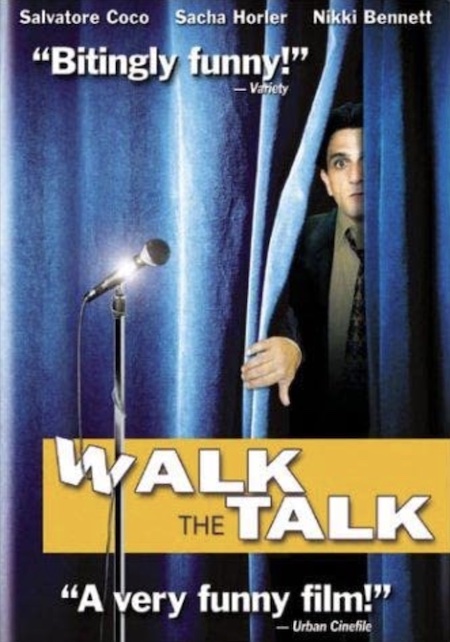
Andrea Byrne, 2004
Rating: M 15+
Release Date: 2001 at the Brisbane International Film Festival.
Cast:
Salvatore Coco - Joey Grasso
Sacha Horler - Bonita
Nikki Bennett - Nikki Raye
Carter Edwards - Marty Raye
Robert Coleby - Pastor Bob
Skye Wansey - Barbara Jacobs-Alsop
John Burgess - Rex Hanna
Jon English - Phil Wehner
Nicky Wendt - Linda Mundell
David Franklin - Trevor Whiteny
Bille Brown - Barry
Crew:
Director - Shirley Barrett
Written - Shirley Barrett
Producer - Jan Chapman
Cast and Crew History:
Director Shirley Barrett previously made Love Serenade in 1996. She also has had a strong input in Australian television. Some shows include:Heartbreak High and A Country Practice. Her first film was a short 19 minute film called Cherith in 1988.
Barrett worked with producer Jan Chapman previously on Love Serenade and also Salvatore Coco in Heartbreak High.
Much of the cast have feature in many Australian films and television series. Sacha Horler and Salvatore Coco in particular have been in many Australian Films.
Release Dates:
The film was released on March 15, 2001 in Australia.
Production:
Walk the Talk was produced by DreamWorks. The film was distributed in Australia by Fox. The film was financed by an American who liked Love Serenade.
Online Presence:
Walk the Talk does not have as much of an online presence as other Australian films, however there were a few places to find information on the film. Information on basic details of the film could be found at www.imdb.com <http://www.imdb.com>. This mainly provided information about the cast and crew and a brief plot synopsis. There was also a link to the film at www.foxmovies.com.au . I used Google as a search engine to find information on the film. This mainly brought up links to www.urbancinefile.com.au <http://www.urbancinefile.com.au> . This site was more useful than the others as it provided reviews and release dates for the film. It also provided audio interviews with the director Shirley Barrett.
Reviews:
There were several reviews of the film found on the Urban Cinefile website.
Andre Urban:
www.urbancinefile.com.au/home/view.asp?a=4573&s=Review
“With Walk the Talk, Shirley Barrett has confirmed her unique talent as a writer and filmmaker.” Andrew L. Urban.
“Barrett has made a very funny film - as distinct from a comedy - but she wisely directed her actors to play it as drama.” Andrew L. Urban.
“Walk the Talk is a brilliant film, at once funny and poignant - this year’s Muriel’s Wedding.” Andrew L. Urban.
Lousie Keller:
www.urbancinefile.com.au/home/view.asp?a=4573&s=Review
“Barrett once again establishes a unique world that entices, beguiles and totally charms us with a beautifully observed screenplay and characters, who although severely flawed, we can’t help but like.” Louise Keller.
“Salvatore Coco has great appeal as the misguided Joey Grasso; being drawn to vulnerability is his strength but also his downfall. Coco offers just the right combination of the earnest, the pathetic and the comic to create a complex character.” Louise Keller
Richard Kuipers:
www.urbancinefile.com.au/home/view.asp?a=4573&s=Review
“Barrett’s choice of setting is an inspired one - the slightly tatty end of the entertainment spectrum on the Gold Coast where dreamers like Joey and modest talents like Nikki Raye scrap around for their slice of the audience dollar.” Richard Kuipers.
“This is a well observed slice of rather deranged Australian life that wins you over with its sincerity.” Richard Kuipers.
“The notable downside is the look of the film. It appears to have been deliberately overexposed on occasions and shot with little or no colour correction in some daylight scenes…I know the idea here was to draw the characters away from potentially garish backgrounds but as a [person] who admires technical innovation and experimentation where appropriate, it simply looked awful to me.” Richard Kuipers.
Interviews:
I found one audio interview for Urban Cinefile with Stuart Parkyn and Shirley Barrett.
Here Barrett describes her view on the genre of the film. When asked if it was a satire, she says “I never wrote it with that intention.” She says she “tried to write a story with characters I care for who are a little misguided.” She also says the film was made for fun and not as a learning experience. She says“Joey doesn’t gain anything from the experience…People sometimes don’t learn.”
Collecting Information:
To collect information on the film, I started by looking at the Fox Movies website. I also looked at the Internet Movie Database and at the Urbancinefile website.
Critical Review
Review
Walk the Talk is about Joey Grasso. The plot is developed retrospectively from Joey’s voiceovers in the narrative. Joey is in jail and looking back at the events which have landed him there. Joey is very misguided and essentially all his trouble starts after attending a self help seminar, where he meets Nikki Raye. Joey decides to start a talent agency. He uses his girlfriend Bonita’s money from her accident insurance payout which left her a paraplegic. Joey makes several attempts to further Nikki’s career. He takes her to meet Rex Hanna (played by John Burgess) and also to a producer. Nikki’s actions continually set back Joey’s efforts. Eventually Bonita’s father steps in and shuts the agency down. Joey then attempts to further Nikki's career. This ultimately lands Joey in Jail.
I liked the film more on the subsequent viewings of it. The particular style of Walk the Talk made it quite difficult for me to initially follow. Although the film is classed as a comedy it does not necessarily follow all comedic conventions. Several dramatic elements are used in particular the acting. There are also many elements of satire and black comedy, which add to the value in the film. At times I felt that the narrative was a little slow, however I think the film is saved by the strong acting from both Salvatore Coco and Sacha Horler.
In general the cast and the characterisation are what makes Walk the Talk enjoyable. The audience will be familiar with several actors in the film. I particularly liked watching John Burgess and Jon English. There is also some very strong acting from Sacha Horler, who plays Joey’s paraplegic girlfriend Bonita. Joey Grasso’s characterisation is also a very interesting part of the film. You can not help but pity Joey’s naivety and ever faithful belief that he can make a difference in the world. No set back is too daunting for Joey and he never seems to learn from them. In a way this makes the film refreshing because it is not about learning a lesson or moral but rather exploring what Joey is like. Joey’s indiscretions add value to the film.
I enjoyed Walk the Talk mainly because it did not follow a conventional storyline. The film laughs at self help gurus and the characters are all interesting.
Critical Uptake on the Film
In general the film received very good reviews with only a few small criticisms made against the film. The film would have been a little bit difficult to understand, due to the fact that it does not follow normal conventions of the comedy genre. The comedy is at times dark and uses many elements of drama particularly the way it was acted by the cast. However some elements of the film would have been very easy to market and very accessible for the audience. This is particularly the familiar cast. The film uses many famous Australian faces, such as Jon Burgess. The critics tended to like the film based on three main areas. These were the characterisation, the setting and the fact that the film was offbeat.
Andrew Urban liked that "the script is a bustling bundle of characters, each identifiable, rounded and complex, even the supports."[1] He also thought the film was particularly successful from the "delivery of exceptional performances." Louise Keller argues that "the entire cast is superb." The acting and characterisation generally were regarded as some of the strengths in the film.
The critics also liked that the film was not conventional. While the film was classed as a comedy Andrew Urban liked it because "there were many elements that help give the film its haunting quality."[2] Others liked that the film was not too serious. Louise Keller liked that the film was "wonderfully offbeat with an acute sense of the ridiculous."
The critics such as Richard Kuipers also liked the inspiration of the Gold Coast setting. They generally found the escapism lifestyle of the Gold Coast to reflect and match on the escapism in the film, particularly Joey's. Andrew Urban found the "Gold Coast to be an ideal setting for the story, where people often search for dreams and success, escape and eternal happiness." Louise Keller found that the Gold Coast "works well as the backdrop for the story of dreams"[3]. However although the setting received positive criticism, some critics did not like that the background was bland. Richard Kuipers thought "it simply looked awful" and hoped that the audience would find it accessible.
Circumstances of production and release.
Walk the Talk is Shirley Barrett's second feature film. She had previously have enormous critical success with her film Love Serenade. This film won her the 1995 Camera d'Or at the Cannes Film Festival in 1996. This film was unusual and considered by critics to be unique. The film was commissioned by an American who had seen Love Serenade and liked it so much that he gave Shirley Barrett creative licence and funding to make another film.[4] Shirley Barrett then wrote the script for Walk the Talk and directed it.
Barrett wanted to make a film that was not predictable and that was unique. She also wanted to make a film with characters that entertained her.[5] This was achieved with the outstanding performances from the cast. Barrett also worked with producer Jan Chapman for Walk the Talk as she had for Love Serenade. A lot of the cast and crew had previously worked with each other in both Australian film and television.
Subsequent and prior works done by the cast and crew.
Shirley Barrett had previously made Love Serenade in 1996 and has not directed any feature films since. However she was the second unit director forPeter Pan in 2003. She had also done a short film in 1998 called Cherith. For all three films Shirley Barrett has both written the screenplays and directed them.
Salvatore Coco has appeared in several Australian films such as Two Hands (1999) and Looking for Alibrandi (2000). Walk the Talk was his first film where he had the starring role. He has not been in any major Australian films since then.
Sacha Horler has probably been the most successful cast member of Walk the Talk. Prior to Walk the Talk she had roles in Australian films such asBlackrock (1997), Soft Fruit (1999) and My Mother Frank (2000). She has since had a supporting role in Russian Doll (2001) and been in Travelling Light (2003).
Position and Value in Australian Film
Walk the Talk is essentially and Australian film. This is particularly due to its setting and content. The film does not follow and conventions of Hollywood, but rather it is unique. Australian films need to complement and supplement Hollywood in order to survive.[6] The narrative is not designed to be a learning experience. Rather the film is more done as an exploration of characters. The film laughs at self help seminars, much like the way that Australians tend to laugh at anything that borders on the ridiculous. Australian films tend to be "quirky"; that is they do something unexpected.[7] Walk the Talk is an unusual film, and it does the unexpected. An example of this is how in the middle of an audition Nikki Raye shoots off a gun as part of her act, much to the amusement of the audience.
Walk the Talk was made in the naughties and would have followed on from the success of other Australian comedies made in the previous decade. Films such as Muriel's Wedding (1994) and Love and Other Catastrophes (1996) were also unusual comedies. Other Australian films released in 2001 wereMoulin Rouge and The Bank.
Walk the Talk has good value in Australian cinema because it presents a lot of cultural diversity. Joey Grasso is of ethnic origin and his girlfriend is a paraplegic. It also show elements of the community at large which are not often explored, such as the church that Joey attends. The film also shows a (quite exaggerated) side to Australian life which is not often seen. The audience is presented with the day to day struggle of an Australian to achieve his dream. It also explores the success crazed Cold Coast but with a darker and grimmer feel to it. In a way the film shows a side of Australia which is different from the stereotypical notions of beaches or open landscapes.
Genre
Walk the Talk borrows from several genres in Australian Cinema. There are elements of comedy, drama and social conscience films. The film is classified as a comedy, however there is a case to be made to say that it is a hybrid between comedy and drama. Walk the Talk could well be classed as a domestic comedy if you allow the category to include communities.[8] While the film does somewhat focus on the domestic relationship between Joey and Bonita, it also focuses on a lightly larger community sphere. These include Joey’s relationship with his one and only client Nikki Raye.
Walk the Talk also uses a lot of satire. Pastor Bob is satirised in the church as is the self help seminar that Joey attends. The characters are also heavily satirised. Joey and Nikki are particularly good targets for a laugh. Joey; because no set back deters him from “making dreams come true” and Nikki because she won’t allow any effort on Joey’s behalf to make her successful.
However, Walk the Talk like many other Australian comedies also has a darkness to it.[9] Joey ultimately shoots Nikki in order to get her fame, which is a convention of black comedies. Another dark or poignant part of the film is his girlfriend Bonita. Bonita is a paraplegic and at one point in the film the spectator learns that it is from a car accident caused by her father. This has severely effected her relationship with him. The film does incorporate many elements of drama in it. The drama essentially revolves around the relationship between Joey, Bonita and her father. Bonita is left angry that she is permanently a paraplegic and has a strained relationship with her father.
[1] www.urbancinefile.com.au/home/view.asp?a=4573&s=Review
[2] www.urbancinefile.com.au/home/view.asp?a=4573&s=Review