
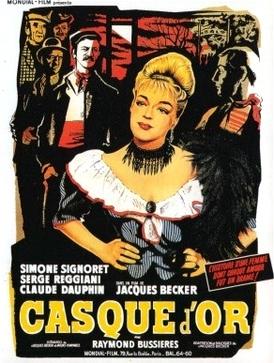
Casque d'or (Jacques Becker, 1952) Simone Signoret, Serge Reggiani, Claude Dauphin
Three gangsters and an ex-con carpenter all fall for the same beautiful golden-haired woman in Belle Époque France.
I was struck by the clarity – and therefore by the inevitability. Although about gangsters, it was like a Greek tragedy.
Peter Bradshaw:
Like Renoir and Ophüls, Becker has a knack of creating densely and vividly achieved visual set-pieces and extravagant, involving drama. Scene follows scene seamlessly and the screen is flooded with detail and incident. Becker uses real locations which have the immediacy of the New Wave Paris movies; perhaps this is the reason for Truffaut admiring Becker so passionately. The tragedy is shot through with a kind of knowing black comedy ... The Guardian.
John Fidler:
Becker makes sense of a nonsensical world in Casque d’or. People dance in the middle of the day. They fight duels with elegantly jewelled knives. They jut their hips, stick out their chins and dare each other to commit acts others only dream of. Becker’s riveting attention to the smallest gesture – the hand of a dying man caressing the face of his killer, the staccato rap of heels on wooden floors or of horses’ hooves on cobblestones, the loud report of all of those face slaps – focuses our attention on this world that seems to make sense only in the country, in Joinville, where the daily distractions of Parisian life are forbidden except in memory. Robert Le Febvre’s searching camera work forces us to watch the characters’ pain and triumph as they scramble through another day. Becker’s talent for immediacy – of sound, image and outpourings from the heart – are what matters in Casque d’or. Senses of Cinema.
Philip Kemp:
This was Becker’s great gift as a filmmaker: to conceive and re-create a world complete in every scrupulously captured detail. Attuned as he was to connections between the trappings of a way of life and the emotions engendered within it, Becker could fix the sense of a period, of a specific juncture of time and place, with quiet precision. Lindsay Anderson, one of Casque d’Or’s earliest champions, noted how here as elsewhere in his work Becker “is fascinated by objects and decors, and the way they can reveal the thoughts, beliefs, and emotions of the men and women who use them.” Every character in the film, no matter how briefly glimpsed, is precisely characterized, giving us the sense that (as Becker himself put it) they all “go on living off-screen, between scenes, even before the film starts.” It’s a world seen whole, neither romanticized nor sensationalized, but presented as a complex, living community in its own right. Criterion.
Garry Gillard | reviews | New: 7 February, 2024 | Now: 29 February, 2024