
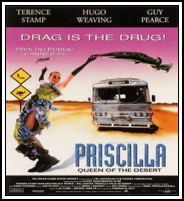
The Adventures of Priscilla, Queen of the Desert
A Latent Image / Specific Films Production
Written and Directed By
Stephan Elliott
Cast
Terence Stamp Ralph/ Bernadette
Hugo Weaving Anthony “Tick”/ Mitzi
Guy Pearce Adam/ Felicia
Bill Hunter Bob
Julia Cortez Cynthia
Alan Dargin Aboriginal Man
Sarah Chadwick Marion
Mark Holmes Benji
Executive Producer Production Designer
Rebel Penfold-Russell Owen Paterson
Produced By Costume Designers
Al Clark and Michael Hamlyn Lizzy Gardiner and Tim Chappel
Cinematography By Music By
Brian J. Breheny Guy Gross
Release Dates
United States of America - 10 August 1994
Australia - 8 September 1994
United Kingdom - 14 October 1994
Box Office (Gross)
$11,059,700 (USA)
£823,293 (UK) (13 November 1994)
AUD 17,000,000 (Australia) ( 1994)
Critic Reviews
- Roger Ebert, Chicago Sun-Times
- James Berardinelli's ReelViews
- Rolling Stone
- San Francisco Chronicle [Mick LaSalle]
- Washington Post [Desson Howe]
- Washington Post [Rita Kempley]
- Urban Cinefile (Australia) DVD Review
- Urban Cinefile (Australia) - 10th Anniversary DVD Review
- Urban Cinefile (Australia) Review
- Apollo Movie Guide [Brian Webster]
- Austin Chronicle [Robert Faires]
- Brilliant Observations on 1173 Films [Clayton Trapp]
- eFilmCritic
- Film Written Capsule Review (Jaime N. Christley)
- Goatdog's Movies [Michael W. Phillips Jr.]
- outrate.net
- The Advocate [Lawrence Frascella]
- Webster's Weekly [Clinton Johnston]
- DVDAnswers.com - region 4 review [Pete Roberts]
- Doug Pratt's DVD Review
- Doug Pratt's DVD Review
- Edinburgh U Film Society [Jan Lawen]
- Movie Reviews UK
- filmcritic.com goes on Adventures with Priscilla
- Metro Pulse (Knoxville TN) [Adrienne Martini]
- FilmInfo FilmFreaks review (dutch)
- Kabinet [Rob Werner]
- Movie Vault [Goatdog]
- moviemaster.de [Frank Ehrlacher] (German)
- OZ Cinema - review by Joshua Smith
- PopcornQ Review
- Prof. Edwin Jahiel
- Radio CityNet (Bello Romano) (Finnish)
- Rotten Tomatoes - Reviews from the Nation's Top Critics
- Trincoll Journal [Gavin Andrews]
- e.p. magazine
Online Presence
Priscilla, Queen of the Desert was very much apart of web literature as displayed by the links above to several articles and publications put online. Especially since the movie was so important to the gay community, there are several discussions referring to the influence of this film in other areas, even the 2004 Olympics when there was talk of a controversial Priscilla type performance done by drag queens. The combination of raw sexual humor, internationally acclaimed costumes, and a timeless soundtrack made this film the subject of a variety of websites. The most informative was the International Movie Data Base, as cited below.
Awards Won
1995 Academy Awards, USA; Oscar for Best Costume Design: Lizzy Gardiner and Tim Chappel
1995 BAFTA Film Award for Best Costume Design: Lizzy Gardiner and Tim Chappel
BAFTA Film Award for Best Make-Up/Hair Design: Cassie Hanlon and Angela
Conte Strykermeyer
1995 Chlotrudis Award for Best Movie
1995 GLAAD Media Award for Outstanding Film
1994 Seattle International Film Festival; Golden Space Needle Award for Best Actor: Terrance Stamp
Golden Space Needle Award for Best Film
1994 Australian Film Institute; AFI Award for Best Achievement in Costume Design: Lizzy Gardiner and Tim Chappel
AFI Award for Best Achievement in Production Design: Owen Paterson
Plot Summary and Personal Review
Priscilla, Queen of the Desert is an outrageous film about the travels of three drag queens, Ralph (aka Bernadette), Adam (aka Felicia), and “Tick” (aka Mitzi), across the Australian outback to reach Alice Springs in order to perform a drag show at a casino/resort. I use “outrageous” not in the pretense that the film is unacceptable, rather that it features flamboyant transsexuals in outlandish costumes as they make their way across vast desert landscapes in a lavender tour bus christened “Priscilla”. Each of the three main characters set out on the voyage for a different reason. Tick, who instigates the whole trip, owes a favor to his estranged wife Marion who is the events coordinator for a casino resort in Alice Springs and who also requests him to visit his young son, Benji, who he has not seen in six years. Adam simply wants to fulfill his dream of climbing to the top of Kings Canyon in full drag. Bernadette has just lost his husband Trumpet and is also getting tired of the same old routine at the drag club in Sydney, so hopes for a change by embarking on this trip. I loved how all three characters filled stereotypical roles of a male adventure film: the wise, older one (Bernadette), the brains and organizer (Tick), and the risk taker (Adam) in a very new light with the addition of obsessed femininity.
The girls venture out into the west, keeping themselves relatively entertained with crude humor, lots of booze, wardrobes full of flashy costumes, and stories of their development into trans-sexuality. They make their first stop in a small town where they appear to be at first unwelcome by the locals when a leader named Shirley refuses Bernadette to order a drink at the pub. Bernadette’s witty comebacks win over the support of the majority of the bar, so the three queens get hammered and are the main attraction of the pub that night. Their acceptance is not universal, however, and they wake in the morning only to see Priscilla covered with the words, “AIDS FUCKERS GO HOME”. It is obvious these words hit home with the girls, but they keep the mood as light heated as possible.
They continue on their journey until the next conflict arises: Priscilla breaks down. At first it appears they are saved when Bernadette finds a husband and a wife traveling in their jeep. However, when they pull up to see Tick dressed in a full length, green, sequined gown, they immediately reverse and the girls are stranded again. That night they practice one of their performances, only to be interrupted by an aboriginal who appears to enjoy the act. He brings them back to his friends and family who are a little wary at first, but who quickly get into the spirit of the bright costumes and classic music the three queens use in their performance. I enjoyed the blending of the two cultures as one Aboriginal man dresses up and joins in the show, and the others add their Didgeridoos to the soundtrack. Back in town, they pick up a mechanic named Bob who will escort them all the way to Alice Springs in order to prevent any further break downs. It appears he chooses to travel with them because his wife Cynthia, a former prostitute, feels under-appreciated, and there seems to be a connection between him and Bernadette. Bob’s loyalty is proven when he stands up against his friends who beat up Adam.
Priscilla and her cargo finally reach Alice Springs and a more accepting crowd. At first Tick is nervous about how his son will react to his sexuality and career choice. Benji surprises him by being amazingly understanding about his father’s identity and demonstrates complete acceptance for both his mother and fathers bisexuality. Bernadette, Mitzi, and Felicia do their gig at the hotel, only to discover their biggest fans are Marion, Benji, and Bob, and unfortunately receive only a mediocre response from the Alice Springs visitors. In the end, Tick gets a new role as a father, Bernadette finds a “real gentleman” in Bob and chooses to stay with him in Alice Springs, and Adam gets to climb Kings Canyon in the dress of his dreams. When it comes down to the ending scene of Mitzi and Felicia performing Abba, it obvious there is “no place like home” because they are back in Sydney and the crowd is going wild.
I found this film to very entertaining and maintain my attention from start to finish. What contributed to this intrigue was the amazing cinematography as it was developed mostly around the contrast of flamboyant homosexuals in some of the gaudiest drag ever created with the vast landscapes of the Australian desert as a background. Also, the crude and racy humor that was found in almost every scene was somewhat shocking, but often hinted at undeniable wit on the part of the screen writers. Terence Stamp, Hugo Weaving, and Guy Pearce all demonstrated their versatility as actors by playing roles remarkably un-masculine as those they have usually been scripted to play. As for the plot itself, it was not terribly exciting as it demonstrated the usual road trip into rough terrain and facing even rougher locals, but the main characters predictably make it to their destination and each reaches their goals they set out to achieve. Despite a less than unique story line, Priscilla, Queen of the Desert will stand out in its viewers’ memories for the indiscriminate look at drag queens and the playful personality that permeates throughout the film.
Critical Review
The critic reviews of Priscilla, Queen of the Desert have been for the most part positive and supportive, averaging about 2.5 out of 4 stars equivalent for their ratings. The movie was overwhelmingly reported as a valued film for its focus on the transsexual community in a non-transcending light. It was able to convey real issues that face the gay community, without being too stereotypical and maintaining humor throughout. As Joshua Smith for Oz Cinema writes, “Priscilla has become an important film in the study of Australia’s portrayal of sexuality on film, as it is on of the first films to celebrate homosexuality rather than to employ it as a shallow, humorous device”.
To most critics, what seems to stand out the most in the film is the crude, sexual humor found in the film that maintains a very witty edge. In the words of critic Clayton Trapp, “There’s very little explicit physical affection, and what little there is balanced by wholesome and morally unassailable brawling and profanity”. The argumentative nature of the characters in the film results in a lot of bitching, but incorporates enough humor to keep your attention. Christopher Null of filmcritic.com describes this characteristic of the film: “For sheer camp value, Priscilla is a lot of fun, even if it has next to nothing to say.”
Overall, it seemed to come down to the conservative nature of the publication as to the extent of support from the reviewer. One example is Desson Howe of the Washington Post who was not a big fan of the movie, but then blamed it more upon his separation from the gay community; “I’ve been told over and over again that I made the mistake of watching The Adventures of Priscilla, Queen of the Desert without the right audience- specifically a raucous, gay one”. I agree with him on the point that the film will be most appreciated by reviewers more involved in the gay community, and to some extent inappropriate to those who hail from more conservative backgrounds.
Other Work of the Priscilla Crew
Writer and Director Stephan Elliott produced another film on drag queens, the 1994 documentary Ladies Please which shortly preceded Priscilla. In 1997, Elliott’s follow-up film, Welcome to Woop Woop, was found equally filled with outrageous characters and an aussie theme, and once again crossing the lines of offensive dialogue.
Lizzy Gardiner who won an academy award for her costume design in Priscilla continued to work with Elliott in Welcome to Woop Woop, as well as being featured in a documentary by Elliott about her work in Priscilla Queen of the Desert and Eye of the Beholder in the film Killing Priscilla (1999).
Terence Stamp was several times nominated for awards for his role in Priscilla. A well seasoned actor, Stamp has been in 58 films since his break out role as Billy Budd in 1962. He has played a wide range of roles, featured as both an antagonist and protagonist throughout the past forty years.
Hugo Weaving played a role quite out of character for himself, as he usually is featured as a very serious character of high stature. In everything from Babe, to The Matrix, to The Lord of the Rings, Weaving plays roles distinguishingly masculine and really contrasting with his part in Priscilla. He is noted for his exceptional number of roles in Australian films.
Relevance of Genre
Priscilla, Queen of the Desert could fit into many genres due to the diversity of the action and dialogue in the film. However, I find that the film is most defined by its qualities as comedy, a road film, and a musical. Priscilla is undeniably a comedy because of the constant use of farcical lines throughout the film. It is described as one of the forerunners of “quirky” comedy that defines many Australian films (Gillard, ch 8, par 4). The three main characters exhibit very random and bizarre behavior that contrasts obviously with their social and environmental surroundings. Their dialogue and appearance combine to identify this film as a situational comedy.
Priscilla is very much a road movie as well. The characters are at the whim of their destination, and the misfortunes that befall them along the way. They also identify very much with their means of transportation, Priscilla, as she becomes dolled up to be just as tacky and flamboyant as her passengers. Even though most Australian road movies focus on the masculinity of the voyagers, the characters in Priscilla definitely take masculinity in a whole other direction. Throughout their journey, though, the queens learn how to depend on one another and even surprise one another as their past and future decisions are to some extent unexpected.
And finally, Priscilla contains many aspects of a musical, even if the characters aren’t singing all the time. The soundtrack is amazing, with several classic cabaret type songs and Australian favorites such as Abba. Music is used to lighten up the more serious scenes to help preserve the comedic edge, as well as to provide transitions between scenes. Since there is a lot of traveling to be involved in this film, the motion from one place to the next is filmed with scenes like the ones of Felicia on the roof of the bus in full drag, belting out to opera songs. Music is used to bring the characters together and generally present the film as an overall good time.
The Presence of Australian Cinema
This film was distinctive in Australian cinema due to its forerunning place as a “quirky” comedy and nonchalant attitude towards transsexuals. The raw and sexual nature of the humor in Priscilla, Queen of the Desert is distinctly Australian, and probably considered more widely acceptable in this country than in those with a more conservative population. There were several key Australian icons throughout the film. Just to name a few: the kangaroo signs, vegemite on toast, endless road into the desert, the nature of the local blokes, the flies, and the use of Australian animals such as emus and horned lizards as costume themes for the performances.
Sources for Research
I found the most helpful database for this film to be International Movie Data Base: http://www.imdb.com/title/tt0109045/
This was the link used for most of my citations as well as the link to the critics used in the review.